The Price You Set Can Make (or Break) Your Sale

KCM • March 1, 2026

The Price You Set Can Make (or Break) Your Sale



There’s one decision you're going to make when you sell that determines whether your house sells quickly, or it sits. Whether buyers make an offer, or scroll past it. Whether you walk away with the maximum return, or you end up cutting the price later.

And that’s your asking price.

The #1 Mistake Sellers Make Today: Trusting the Wrong Number

If you’re thinking of moving and trying to figure out what your house may sell for, it’s tempting to start with an online home value tool. They’re fast, free, and easy. And you don’t have to talk to anyone. But here’s the problem: they don’t know your house.

And that can be a bigger drawback than you realize.

Where Online Estimates Fall Short 

Online tools often lag behind the market. They look in the rearview mirror, relying on closed sales and delayed information. And in that sense, they’re using incomplete data.

That’s not a miss in how these systems are built. Some information just isn’t available online. Bankrate explains:


“While these tools can be a useful starting point, keep in mind that they typically do not provide the most accurate pricing. Algorithms can only rely on the information available; they can’t account for things like a home’s condition or renovations made since the last public information was updated.”

They can’t see:

  • The unique features that make your house special
  • All the work you’ve put in to keep it in good condition
  • Or, how in-demand your specific neighborhood is right now

So, while they may do a good job in some cases, they can’t be as accurate as a local agent who has boots on the ground day in and day out.

In a market where buyers have more options, a seemingly small margin of error can cost you thousands if you price too low, or weeks of lost momentum and time if you price too high.

If you want to sell for the most money and in the least amount of time, you don’t want the fast answer on how to price your house. You want the right one.

That’s why the savviest homeowners today don’t rely on algorithms when it actually matters. They rely on people, specifically trusted local agents.

What an Expert Agent Brings to the Table

According to 1000WATT, sellers overwhelmingly believe real estate agents have the best sense of a home’s true value, far more than any automated tools.

That confidence isn’t accidental. As Bankrate puts it:


“A professional appraiser or real estate agent can visit the home in person, assess the neighborhood as a whole as well as the individual property, perform more thorough market research, and consider subjective details.”

And those details matter. A skilled local agent doesn’t just pull reports. They know what’s happening right now:

  • What buyers are paying this month, not last month, or even last year
  • How your home compares to the current competition in your neighborhood
  • Which features add value based on what buyers are willing to pay for today
  • How to price your house to create urgency in this market

And once an agent steps foot in your house, they may even find your online estimate undershot your value. So, if you stuck with the estimate you got online, you’d actually be leaving money on the table. And no one wants that.

Bottom Line

While online tools can give you a rough starting point, only a local expert can give you a price that actually works.

If you want to know the right number for your house, not just the easiest one to find, let’s talk.

Share this post

By KCM • November 26, 2026
A Fixer-Upper Could Be Your Path To Homeownership When the homes you love keep landing outside your budget , it may be time to look at the ones other buyers skip. A fixer-upper won't be the right call for everyone. Plenty of buyers want a home that's ready on move-in day. But homes that need some updating could get you in the door for a lot less . More buyers are starting to realize it too. And Danielle Hale, Chief Economist at Realtor.com, explains why: “ Fixer-uppers give buyers a way to break into the housing market at a time when affordability is still stretched thin. For those with the vision. . . fixer-uppers provide both a starting point in the market and the chance to create a home that's truly their own.” If that sounds like you, here's why a fixer-upper could be worth a closer look. The Price Tag Is Usually Lower Because these homes need work, they tend to have a lower asking price up front. According to AmeriSave, fixer-uppers usually sell for 20% to 30% less than what they're worth on the market. Here's what that could look like. KCM applied a 25% discount – the middle of that range – to the median home price from the National Association of Realtors (NAR). This is an example, not the average price of a fixer-upper. But it shows the savings could top $100,000 (see graph below): That's a big difference up front and it could be what gets you into a home today. And odds are you don’t have to tackle all the repairs at once – you can space them out over time as it works for you. Just remember repair costs can add up quickly and eat into those savings if you don't plan ahead. So, before you make an offer, get estimates from a contractor and set a repair budget you're comfortable with. There are even some loan types designed to help pay for the work. One Loan Can Cover the Home and the Repairs With a renovation loan, you can roll the cost of the work into your mortgage, so you don't have to cover it all out of pocket once you move in. Here are a few options from FHA , Fannie Mae , Freddie Mac , and the VA (see visual below): Each program has its own rules, and not every lender offers all of them. So, talk to a trusted lender to see which options are available to you and which make sense for how you plan to tackle updates and repairs over time. Don't Overlook Local Perks Some cities even offer tax breaks to buyers who renovate a fixer-upper and raise its value. These programs vary by location, so check with your city or a tax professional to see what's available where you want to live. If you want to check for more information yourself, go to your local county or city official dot-gov website. Then, use the search bar and look for: [City or County Name] AND “home rehabilitation” OR “property tax incentive” OR “housing repair” A local agent can also help you find fixer-uppers in the neighborhoods you have your heart set on. Bottom Line If move-in-ready homes keep coming in over budget, a home that needs some TLC could be your way in. Plan your repair budget and line up the right loan before you buy, and you can get in the door now and make the space your own over time, as your budget allows. Let's connect so you can start looking at fixer-uppers in the neighborhoods you love.
By Realty Boulevard • November 25, 2026
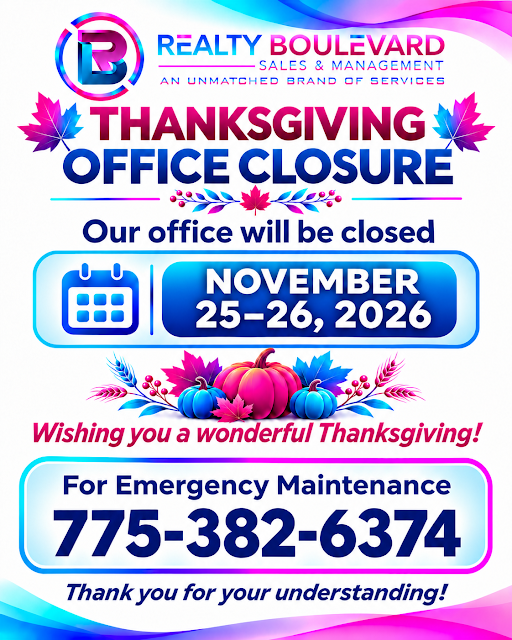
Realty Boulevard will be closed on November 25–26, 2026 in observance of Thanksgiving. We wish you and your loved ones a joyful Thanksgiving Day and a wonderful holiday weekend! For any urgent emergency maintenance needs while our office is closed, please contact 775-382-6374 . Thank you for your understanding! 🦃🍁✨
By The Lighter Side of Real Estate • September 1, 2026
Every year, on the third Saturday of July, millions of people celebrate National Toss Away the “Could Haves” and “Should Haves” Day. OK… maybe not millions. But somebody probably does! While it’s not exactly the kind of holiday most people mark on their calendars, it’s built around an idea that’s surprisingly relatable. We all have moments we wish we could do over. Maybe you could have invested in a company before its stock took off. Maybe you should have kept that classic car instead of selling it years ago. Maybe you could have taken that job, started that business, or simply made a different decision somewhere along the way. Real estate has no shortage of “could haves” and “should haves,” either. In fact, one that’s been floating around quite a bit lately sounds something like this: “Maybe I should have sold my house a few years ago.” “Maybe I’ll just wait until the market gets better…” If you’ve been paying attention to the housing market lately, you may have noticed that some homeowners are putting their houses up for sale… and then deciding to take them back off the market. According to recent data , delistings have been on the rise as more sellers decide they’d rather wait than accept a market that isn’t quite living up to their expectations. In fact, they’re delisting at the highest rate since 2020, right around the time the pandemic began. When you think about it, it’s not hard to understand why. For several years, many sellers got used to homes selling almost immediately, multiple offers arriving within days, buyers waiving contingencies, and offers coming in above asking price. But, as real estate markets tend to do, they’ve changed in many areas. Depending on where you live, and the price range your home is in, buyers may have more choices than they’ve had in years. They may take longer to make a decision. They’re more likely to ask for inspections, repairs, seller concessions, or simply negotiate harder than they would have a few years ago. For some homeowners, that shift is frustrating enough to make them think… “Maybe I’ll just wait until the market gets better.” And for some people, that may absolutely be the right decision. Two Thoughts That Are Closer Than They Appear What’s interesting is that the two thoughts we’ve been talking about are actually pretty close cousins. “Maybe I should have sold my house a few years ago.” “Maybe I’ll just wait until the market gets better.” One is based on wishing you could go back and capitalize on yesterday’s market. The other is based on hoping you’ll recognize the right time to capitalize on tomorrow’s. They’re both completely understandable. In fact, they’re probably thoughts just about everyone has had at one point or another—not just in real estate, but in life. The catch is that neither one is particularly helpful when you’re trying to decide what to do today. After all, you can’t sell your house three years ago. And no one—not even the smartest economists—knows exactly what the housing market is going to look like three years from now. Or any other number of years for that matter. You can only make decisions based on what the market is currently doing. The Problem With Using Extraordinary as Your Baseline It’s also worth remembering that today’s market isn’t necessarily a bad market for sellers. In many parts of the country, home prices are still historically strong. In fact, if you ask many buyers how they feel about today’s market, there’s a good chance they’ll tell you homes are still too expensive and affordability remains one of their biggest challenges. What’s changed isn’t necessarily that sellers have lost all of their leverage. It’s that many of them have lost the extraordinary leverage they enjoyed just a few years ago. But now your home may take a little longer to sell. You might not have quite as many showings. Your buyer may ask for repairs or seller concessions that would have been laughed off during the frenzy of the pandemic market. None of those things necessarily mean it’s a bad time to sell. They may simply mean the market has become a little more… normal. And normal can feel disappointing when you’re comparing it to one of the strongest seller’s markets in modern history. Every Market Creates a Few “Should Haves” One of the interesting things about real estate is that every market eventually becomes the one somebody wishes they’d taken advantage of. Looking back, it’s easy to find a market where you wish you had bought, sold, or invested. The challenge, of course, is that nobody knows which market people will be saying that about until years later. Will some homeowners who decide to wait ultimately be glad they did? Absolutely. Every seller’s situation is different, and for some, waiting may prove to be exactly the right decision. But chances are, this market will also become one that at least some homeowners eventually look back on and say, “I probably should have sold then.” The only problem is that none of us knows which market that will be until we’re looking at it in the rearview mirror. That’s why “could haves” and “should haves” usually aren’t the best guide when making real estate decisions. They only show up after the fact. If you’re debating whether to sell now, wait a while, or even relist a home you recently took off the market, one of the smartest things you can do is have a conversation with a knowledgeable real estate agent. They can help you evaluate your local market, your personal situation, and your long-term goals so your decision is based on today’s realities—not yesterday’s regrets or tomorrow’s unknowns. And if nothing else, perhaps National Toss Away the “Could Haves” and “Should Haves” Day is a good reminder that yesterday’s market is gone, tomorrow’s market hasn’t arrived, and today’s market is the only one any of us actually gets to make decisions in.
Show More