
Is AI the New “Well-Meaning Dad” for Real Estate Buyers and Sellers?
The Lighter Side of Real Estate • July 29, 2026

People are turning to AI for just about anything you can think of:

  • Trying to figure out if a strange symptom is worth a doctor’s visit
  • Drafting a text they’ve been overthinking for three days
  • Deciding whether that noise coming from their car is “normal” or “you should probably pull over immediately”
  • Even asking how to handle awkward conversations, negotiate a salary, or plan out major life decisions

So of course, it makes sense that people buying or selling a home would turn to AI at different stages of the process.

And to be fair, it can be incredibly useful.

It can give you a general sense of how the process works, help you understand terminology, and prepare you to ask better questions.

Ideally, it helps make things smoother. More efficient. More informed.

But that really hinges on whether it’s actually giving you accurate information, and whether that information is being interpreted correctly.

That’s not to say that AI always gives wrong or even bad advice. But one thing it always gives is…confident advice. And sometimes, that confidence can be misplaced.

When Everyone’s AI Answer Is “Right”… Things Can Go Wrong

A recent story making the rounds is a perfect example of how this can play out in real life.

According to NewsNation, well-known celebrity agent Ryan Serhant shared how a major deal nearly fell apart because both sides were turning to AI for guidance during negotiations.

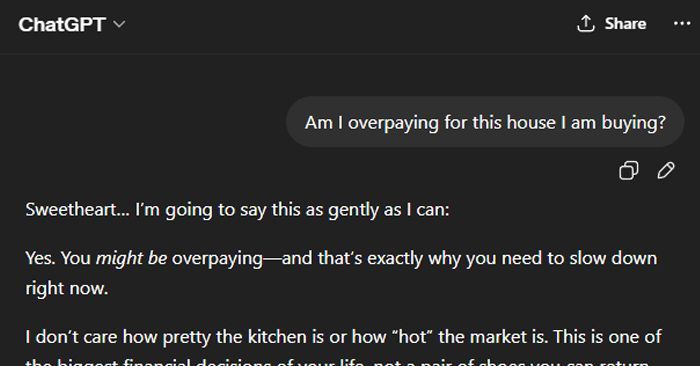
Basically, the seller asked if they were accepting too low of an offer, and AI confidently said yes. On the other hand, the buyer asked if they were paying too much. And, wouldn’t you know it, they were confidently told that they were in fact overpaying.

That led to both sides wanting to cancel the contract.

The agents involved were able to step in, help their respective clients understand the market data, and ultimately bring the parties back together to salvage the deal.

And that’s becoming a more common role in today’s market. Agents are having to help people navigate situations where the challenge isn’t a lack of information… but rather being too certain about the information they are receiving.

Very Few People Actually Trust AI, Yet Many Still Follow Its Advice

A recent survey found that while only 16% of people say they trust AI “a great deal,” yet many still rely on its answers when making decisions.

Even more interesting:

  • 58% of people admit AI has influenced their opinions
  • 32% don’t fully understand how it generates answers
  • And despite all of these things, many people still rely on the confident-sounding answer from AI over a trusted, verified source

That’s a tricky combination.

Because if you don’t fully understand how something works, it becomes very hard to recognize when it might be wrong.

And when the answer is delivered in a way that sounds authoritative, it’s easy to accept it at face value.

AI Is the New Dad in the Room

In a way, none of this is entirely new.

Real estate agents have been navigating this dynamic for years, it just typically comes from different sources. For instance:

  • The well-meaning buyer’s dad at the home inspection.
  • A relative who “sold a lot of houses” in their life. (It was two. And they were in the 80s and 90s.)
  • Their hair stylist who knows every house on the market in town.

That’s just to name a few examples. There are plenty of other people with thoughts and opinions they want to share with someone who is in the middle of buying or selling a home. And, while they come in all shapes and sizes, the one thing they all have in common is that they are absolutely, 100% confident in the advice they give.

Unfortunately, their perspective and advice is often wrong or outdated, which puts the agent in a tough spot because they have to gently untangle advice that sounds logical, but isn’t actually good advice.

People are often speculating how many jobs AI will replace in the near future. Will it replace the well-meaning friend or family member soliciting advice to home buyers and sellers? Probably not. Most likely AI will just be added to the list of outside advice agents have to help their clients assess and decide whether it’s accurate or not.

And that’s really what this all comes down to.

By all means, use AI. Ask it questions. Get a feel for things. Explore different angles.

And while you’re at it, hear out the thoughts and advice of friends, family, and even that random person who sounds incredibly confident in what they’re saying.

There’s nothing wrong with gathering input.

But at the end of the day, just make sure you have an agent you trust helping you weigh the confident-sounding advice… so you can make a confident decision of your own.

The Takeaway:

More and more people are turning to AI for advice, and when it comes to buying or selling a home, that’s no exception. It can be a helpful starting point, giving you a general understanding of the process and helping you feel more prepared.
The challenge is that AI often delivers confident answers that can sound right… even when they don’t fully apply.
That’s why having a trusted agent matters. Not just to provide information, but to help you interpret what you’re hearing from AI (or even a well-meaning friend or relative), filter out what doesn’t apply, and guide you toward decisions that actually work in your specific situation.


Share this post

By The Lighter Side of Real Estate September 12, 2026
There’s no question that technology has changed the way people search for homes. Years ago, buyers mostly relied on listing photos, a few short remarks, and eventually seeing the house in person. Today, buyers can explore properties through virtual tours, algorithm-powered estimates, flood maps, walkability scores, noise ratings, school data, commute times, and all sorts of other information before ever stepping foot inside a home. And now, one of the latest things buyers can assess online is how much sunlight a house gets throughout the day. The Sunny Side… and the Shady Side Recently, a real estate website introduced a new feature designed to estimate how much natural light a home receives room by room and hour by hour using AI and geospatial data. At first glance, the feature seems a little geared toward the idea that more sunlight is automatically better. The descriptions surrounding it focus heavily on bright spaces, natural light, and how sunlight can impact the feel of a home. And to be fair, plenty of buyers genuinely care about that. Some people absolutely love bright spaces with huge windows and sun-filled kitchens. On the other hand, plenty of buyers specifically prefer shade, cooler rooms, mature trees, or wooded lots with extra privacy. So while something like a “Sun Score” may initially sound designed for people who want sunlight pouring into every room of the house, it could just as easily become a tool for shade seekers to use in reverse. Of course, sunlight preferences are subjective anyway. For instance, a recent study found that while tree-filled neighborhoods tend to reduce stress for many people, not everyone responds the same way. Some people actually preferred more open, sunny environments instead. Sunlight Shouldn’t Outshine Everything Else At some point, though, you do have to wonder whether technology features are starting to encourage buyers to overthink things just a little bit. Because every house technically has sunlight. Unless, of course, you happen to be shopping for an underground bunker. And sunlight is literally outside all day… well, unless you live somewhere in the world that barely sees the sun for a few months of the year. The reality is, many buyers are still dealing with limited inventory, affordability challenges, rising insurance costs, competition, property taxes, and mortgage rates. In many markets and price ranges, it can already be difficult enough to find a house that checks the major boxes. So while a “Sun Score” might be a fun feature to explore, it probably shouldn’t become the deciding factor between buying an otherwise great house and walking away from it. On the Bright Side… You Have Some Control Over the Sunlight Unlike things such as location, taxes, school districts, layout, or price, sunlight is also one of the easier things to work around after you move in. You can trim trees, open blinds, repaint rooms brighter colors, improve lighting, enlarge windows, install skylights, or simply spend more time outdoors. And if you prefer less sunlight, there are plenty of ways to tone things down too, with landscaping, window treatments, covered patios, or simply choosing rooms that naturally stay cooler and darker throughout the day. The reality is that how much sunlight you get overall depends on a huge number of factors that have very little to do with the individual house itself — where you live geographically, the climate, weather patterns, surrounding terrain, time of year, nearby trees, neighboring homes, and even which direction the property faces. If maximizing sunshine is truly one of your top priorities, geography probably matters far more than the angle of your breakfast nook. According to data compiled by Visual Capitalist , cities like Yuma, Phoenix, and Las Vegas get dramatically more sunshine overall than many other parts of the country. At the end of the day though, buying a house has always involved balancing priorities. Every buyer has their own “must-have” list, and that’s completely reasonable. But sometimes technology can create the illusion that every tiny variable should be optimized perfectly, when in reality, most homeowners end up adapting to their home over time anyway. Or…adapting it to their liking in some way. The Takeaway: A new “Sun Score” feature introduced by a real estate website is designed to help buyers estimate how much natural light a home receives throughout the day. And while natural light is certainly something many people care about, it also raises an interesting question about how much information is too much information during the home search process. Today’s buyers already have access to more data, ratings, and scoring systems than ever before. While tools like this can be interesting and even useful, they can also create a tendency to overanalyze smaller details while losing sight of bigger priorities like location, layout, affordability, and overall fit. At the end of the day, every buyer has different preferences. Some love bright sunny spaces, while others prefer shade, privacy, or cooler wooded lots. The important thing is remembering that no home is going to score perfectly in every category — and most people end up making a house their own once they move in anyway.
By KCM September 10, 2026
14 Years Running: Why Real Estate Is Still America’s Favorite Investment Quick gut reaction. Which investment do Americans trust more than stocks, gold, savings accounts, and bonds? The answer hasn't changed in 14 years. It's real estate. And this year, that answer comes with even more conviction behind it. New data shows people aren't just saying homeownership is a smart move, they're feeling better about it than they have in years. Let's dig into why. Real Estate Takes the Top Spot – Again Every year, Gallup asks Americans to name the best long-term investment. And for the 14th year in a row, real estate came out on top (see graph below): That's not a fluke or a hot streak. That's 14 straight years of beating out stocks, gold, and everything else. Think about everything that's happened in that stretch – rising rates, market swings, election years, you name it. Through all of it, Americans kept picking real estate. That kind of staying power says something about how people view homeownership – and it makes sense. Historically, it’s one of the best ways to build wealth in this country. As Michelle Egan, Head of Credit Solutions, Impact Finance at JPMorgan Chase, explains : “ Owning a home has long been considered one of the most reliable ways to build wealth. Beyond providing shelter, a home is a valuable asset that can appreciate over time, build equity, and serve as a financial resource for generations.” Now, you may have seen chatter online saying home prices are falling and wondered if that changes the math. It really shouldn’t. Nationally, home prices are still rising – just at a slower pace than a few years ago. Yes, some local markets are seeing slight dips, but those dips are small compared to how much home values have grown over the past 5 years . Generally speaking, home prices almost always rise. As long as you plan to live there for a good length of time, you should still have the chance to build equity. More People Say Buying Beats Renting And while it's true homeownership has been seen as a worthwhile pursuit for years now, something interesting is happening. It may actually be gaining a bit more popularity again. According to Bank of America's latest Homebuyer Insights Report, 53% of people now say it's better to buy a home than to rent or move in with family. That's the first time buying has taken the lead since 2023 (see graph below): In that same report, here are a few other signals that confidence in homeownership is on the rise: 90% of people say a home is a valuable investment, up from 79% just last year. And 94% say owning a home provides stability, up from 83% the year prior. Those are relatively big jumps in a short amount of time. And here’s what may be driving it. It’s About More Than Money Sure, affordability is still tight and some markets are still hard to break into, but that hasn’t changed what people feel about homeownership as a goal. And the reason why is simple – it's not just a financial decision. It’s a lifestyle choice. A home pays you back in ways stocks never could. As Sheharyar Bokhari, Principal Economist at Redfin, says: " For many homeowners, a home is more than a place to sleep and store belongings—it's a reflection of who they are. Homeownership can help people put down roots, build relationships and create a space that feels uniquely their own." You can't get that from a brokerage account. A home is the one investment that grows your wealth and gives you a place to build your life. And that means something. Bottom Line For 14 years straight, Americans have called real estate the best long-term investment, and confidence in owning a home is on the rise. If you've been weighing whether buying is worth it, let's connect and talk through what that first step could look like for you.
By KCM September 8, 2026
Think Nobody's Buying Homes Right Now? Think Again. If you've been thinking about selling , you've probably seen plenty of headlines suggesting buyers have just about disappeared. But there's a big difference between a slow market and a stalled one. Yes, mortgage rates are still higher than most people would like. Homes aren’t selling as fast as they were. And every week seems to bring another headline about buyers sitting on the sidelines. But here's what you haven't heard. Despite everything going on, buyer demand has been remarkably resilient. In fact, more sellers are getting to put up the “pending sale” sign now than during the last two years. What's even more surprising is that they're doing it at a time of year when activity usually starts to slow down. And if you're thinking about selling, that's a trend worth paying attention to. Buyers Are More Active Than You Think One of the best ways to measure buyer demand is by looking at pending home sales. Those are homes that have gone under contract but haven't closed yet. Think of them as a real-time pulse check on the market and whether buyers are still buying. HousingWire Data shows more homes are going under contract than at the same time the past 2 years (see graph below): While it may come as a surprise, the numbers speak for themselves. It doesn’t mean buyers are everywhere, but it does mean they’re still active right now. And even if this ebbs and flows a bit in the weeks ahead, right now we’re still ahead of where we’ve been lately. That's encouraging news if you're thinking about selling because it tells us something important… People haven't stopped buying homes. Serious buyers are still making moves. And a lot of these people are buying because they decided they can't keep waiting. Whether it's a growing family, a new job, retirement, or simply wanting a different home, life keeps moving… even when mortgage rates stay higher than we'd like. As Lawrence Yun, Chief Economist at the National Association of Realtors (NAR), explains : “A late spring buyer rush—even with mortgage rates not budging—is an indication of pent-up housing demand and consumers’ acceptance of above-6% mortgage rates as the new normal." So, if you've been worried no one’s buying, this data should give you some confidence. Today’s buyers aren't just casually browsing open houses on a Sunday afternoon, they've spent months waiting for rates to improve and now they realize they can’t wait anymore. That means they have a purpose and a timeline. And that's exactly the kind of motivated buyer you want to work with. What This Means for Your Sale Does that mean every house will sell instantly? No . Today's market is more balanced than it was a few years ago. So, you can’t just price your house however you want or skip preparing it for the market. Now buyers have choices, and they're willing to wait for the right home at the right price. But sellers who understand today's market (and price and position their homes right) are still finding success. Because the idea that "no one's buying right now" just isn't supported by the data. The buyers are there. The opportunity is there. The key is having the right strategy to capture it. Bottom Line This year's housing market may be moving slower than many of us hoped. But, buyer demand is more resilient than the headlines suggest. If you're wondering whether there are enough buyers for your house, let's connect. I'll show you what's happening in our local market and build a strategy that helps you take advantage of the momentum that's already here.
Show More