Is AI the New “Well-Meaning Dad” for Real Estate Buyers and Sellers?
The Inner Circle • March 31, 2026

People are turning to AI for just about anything you can think of:

  • Trying to figure out if a strange symptom is worth a doctor’s visit
  • Drafting a text they’ve been overthinking for three days
  • Deciding whether that noise coming from their car is “normal” or “you should probably pull over immediately”
  • Even asking how to handle awkward conversations, negotiate a salary, or plan out major life decisions

So of course, it makes sense that people buying or selling a home would turn to AI at different stages of the process.

And to be fair, it can be incredibly useful.

It can give you a general sense of how the process works, help you understand terminology, and prepare you to ask better questions.

Ideally, it helps make things smoother. More efficient. More informed.

But that really hinges on whether it’s actually giving you accurate information, and whether that information is being interpreted correctly.

That’s not to say that AI always gives wrong or even bad advice. But one thing it always gives is…confident advice. And sometimes, that confidence can be misplaced.

When Everyone’s AI Answer Is “Right”… Things Can Go Wrong

A recent story making the rounds is a perfect example of how this can play out in real life.

According to NewsNation, well-known celebrity agent Ryan Serhant shared how a major deal nearly fell apart because both sides were turning to AI for guidance during negotiations.

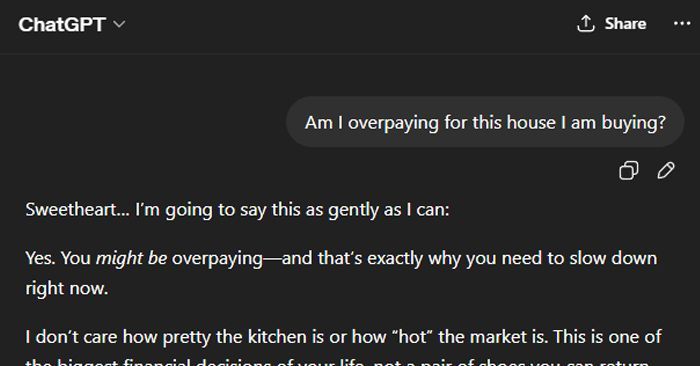
Basically, the seller asked if they were accepting too low of an offer, and AI confidently said yes. On the other hand, the buyer asked if they were paying too much. And, wouldn’t you know it, they were confidently told that they were in fact overpaying.

That led to both sides wanting to cancel the contract.

The agents involved were able to step in, help their respective clients understand the market data, and ultimately bring the parties back together to salvage the deal.

And that’s becoming a more common role in today’s market. Agents are having to help people navigate situations where the challenge isn’t a lack of information… but rather being too certain about the information they are receiving.

Very Few People Actually Trust AI, Yet Many Still Follow Its Advice

A recent survey found that while only 16% of people say they trust AI “a great deal,” yet many still rely on its answers when making decisions.

Even more interesting:

  • 58% of people admit AI has influenced their opinions
  • 32% don’t fully understand how it generates answers
  • And despite all of these things, many people still rely on the confident-sounding answer from AI over a trusted, verified source

That’s a tricky combination.

Because if you don’t fully understand how something works, it becomes very hard to recognize when it might be wrong.

And when the answer is delivered in a way that sounds authoritative, it’s easy to accept it at face value.

AI Is the New Dad in the Room

In a way, none of this is entirely new.

Real estate agents have been navigating this dynamic for years, it just typically comes from different sources. For instance:

  • The well-meaning buyer’s dad at the home inspection.
  • A relative who “sold a lot of houses” in their life. (It was two. And they were in the 80s and 90s.)
  • Their hair stylist who knows every house on the market in town.

That’s just to name a few examples. There are plenty of other people with thoughts and opinions they want to share with someone who is in the middle of buying or selling a home. And, while they come in all shapes and sizes, the one thing they all have in common is that they are absolutely, 100% confident in the advice they give.

Unfortunately, their perspective and advice is often wrong or outdated, which puts the agent in a tough spot because they have to gently untangle advice that sounds logical, but isn’t actually good advice.

People are often speculating how many jobs AI will replace in the near future. Will it replace the well-meaning friend or family member soliciting advice to home buyers and sellers? Probably not. Most likely AI will just be added to the list of outside advice agents have to help their clients assess and decide whether it’s accurate or not.

And that’s really what this all comes down to.

By all means, use AI. Ask it questions. Get a feel for things. Explore different angles.

And while you’re at it, hear out the thoughts and advice of friends, family, and even that random person who sounds incredibly confident in what they’re saying.

There’s nothing wrong with gathering input.

But at the end of the day, just make sure you have an agent you trust helping you weigh the confident-sounding advice… so you can make a confident decision of your own.

The Takeaway:

More and more people are turning to AI for advice, and when it comes to buying or selling a home, that’s no exception. It can be a helpful starting point, giving you a general understanding of the process and helping you feel more prepared.
The challenge is that AI often delivers confident answers that can sound right… even when they don’t fully apply.
That’s why having a trusted agent matters. Not just to provide information, but to help you interpret what you’re hearing from AI (or even a well-meaning friend or relative), filter out what doesn’t apply, and guide you toward decisions that actually work in your specific situation.


Share this post

By KCM May 15, 2026
More Options Are Popping Up This Spring Did you try to buy a home last year, but you ended up pressing pause? Maybe you couldn’t find a home that really fit your needs. Or maybe the ones you liked just weren’t affordable. According to a recent survey from NerdWallet, those were the top two reasons buyers gave up on their search in 2025. But this Spring, there's one trend that could help fix both of those frustration points: more homes are hitting the market. The Number of Fresh Listings Is Almost 2x Higher Than a Few Months Ago Data from Realtor.com shows there are nearly 2x as many new listings hitting the market today as there were just 3 months ago. Those are homes the seller just put up for sale ( see graph below): That’s a significant rise. And while we usually see an uptick as we head into the busiest time of the year, this increase was bigger than normal. Jake Krimmel, Senior Economist at Realtor.com, explains : “ New listings jumped 21.2% from February to 439,000, a larger-than-typical seasonal surge . . . March typically sees the biggest month-over-month jump in new listings of the entire buying season, averaging an 18% increase since 2017; this year it exceeded 20%.” That means more sellers are jumping back into the market, and that’s giving buyers more fresh options to choose from. So, if you’d felt like you’d seen everything out there and still nothing was quite right, this may be your moment. With that many “just listed” homes, one of them could be exactly what you’ve been searching for. Where You Have More Options And this trend is happening across most of the country, so you should have more options pretty much whereever you are. Earlier this year, the Northeast had fewer new listings because winter storms delayed sellers from putting their homes on the market. But now, that region is catching up fast. In March, new listings jumped across nearly every state, especially in the Northeast, helping drive a strong national rebound. What Rising Inventory Means for You Right now, there are almost a million homes for sale nationwide. That’s up over 8% compared to last year. With that many homes on the market, there’s a much better chance something will fit what you’re looking for, especially with so many fresh options being added right now. As Odeta Kushi, Deputy Chief Economist at First American, explains : “One of the most encouraging signals heading into the spring home-buying season is the improvement in for-sale inventory levels compared with last year. . . More homes on the market give buyers greater choice and, combined with improved buying power, expand the range of homes they can realistically consider. ” In other words, your search may feel very different this year. Bottom Line More fresh listings are hitting the market right now, and that’s creating real opportunity. If you put your search on hold last year, this Spring may be the time to jump back in. Let’s take a look at what just hit the market and see what could work for you.
By KCM May 14, 2026
The body content of your post goes here. To edit this text, click on it and delete this default text and start typing your own or paste your own from a different source.
By KCM May 3, 2026
Rent or Buy? The Real Tradeoff Most People Don’t Talk About You’ve probably asked yourself lately: Is it even worth trying to buy a home right now? It’s a question a lot of people are asking. With today’s home prices and mortgage rates, renting can feel like the easier path. In some cases, it might even seem like the only realistic option right now. And if that’s where you are, there’s nothing wrong with that. But if you’re weighing the decision, there’s one part of the conversation that doesn’t get talked about enough. It’s what each choice does for your future. What Renting Really Gets You (And What It Doesn’t) Depending on your situation, renting does have some advantages: Lower upfront costs. Less responsibility. More flexibility to move when you want. But even with those benefits, a Bank of America survey found 70% of aspiring homeowners worry about what long-term renting means for their future. And that concern comes down to one thing: you’re not building anything for your future. As Yahoo Finance explains: “Paying rent doesn't build equity. You get a place to live, but no ownership stake, no price appreciation, and no asset to leverage for future borrowing or investment .” So, while renting may feel easier, the flexibility you get comes at a cost. How Homeownership Builds Your Wealth Over Time On the other hand, owning a home is one of the most consistent ways people build wealth over time. Why? When you’re a homeowner, you gain something called equity . That’s the difference between what your home is worth and what you owe. That equity grows with every monthly payment you make. It also gets a boost as home values go up through the years – and it adds up quicker than you may think. Today, the National Association of Realtors (NAR) says the average homeowner’s net worth is 43X greater than that of a renter: The dollars in the visual don’t lie. On average, here’s how net worth compares: Homeowners: $430k Renters: $10k And it’s not because homeowners make wildly different decisions day to day. It’s because over time, one path builds something, and the other doesn’t. So sure, buying comes with some upfront costs and more responsibility. But it’s basically a savings account you can live in. The Gap Is Growing Over Time And here’s something else interesting. That net worth gap between renters and homeowners has been widening over time, not shrinking. If you look back at the reports on net worth through the years, you can see the gap is growing as homeowners gain wealth and renters stay stuck in the rental trap (see graph below): Even in 2025, when home prices were moderating, homeowners still gained even more ground. And that tells you something important: When you can afford it and you’re ready for the responsibility, history shows buying is usually worth it in the long run. Because either way, you’re paying for someone’s mortgage and building someone’s net worth. When you rent, it’s your landlord’s mortgage – not yours. But when you buy? Your monthly payments help build equity. The question is: whose do you want to pay? Yours or theirs? So, Should You Buy a Home Now? The short answer is, it depends on your situation. While the long-term benefits of buying are clear, that doesn’t mean the timing is right for everyone right now. And that’s okay. You should only buy a home once you’re ready and the numbers work for you. But whether you’re looking to buy now or planning for the future, the first step is the same. You should have a quick conversation with a local real estate agent about your goals, timeline, and budget. They can help you run the numbers and see what’s realistic. You may find buying is closer than you thought. And if not, you’ll at least know exactly what it will take to get there. Because the sooner you have a plan , the sooner you can decide when it makes sense, instead of wondering if it ever will. Bottom Line Renting may feel more do-able today. But over time, it could cost you . If you want to ditch renting and start building something for your future, it starts with a simple conversation. Let’s connect, talk about your specific goals, and explore your options – so you’re ready when the time is right for you.
Show More